
Are you planning to apply for a fully funded PhD scholarship in 2027? If yes, preparing a strong Statement of Purpose (SOP) is an essential step in your doctoral application. A PhD scholarship SOP helps the admission committee understand your academic background, previous research experience, research interests, and specific reasons for choosing a particular university.
Many international postgraduate students complete their MS or MPhil degrees but struggle to explain their research experience in a clear and convincing way. They may have completed a thesis, worked on research projects, or developed laboratory skills, but they do not know how to present these achievements effectively in a PhD application. In this detailed guide, you will learn how to write an SOP for a PhD scholarship step-by-step, what to include in each section, how to explain your research interests, and how to select a suitable university and supervisor. A complete PhD SOP sample is also included for guidance.
1. What Is a PhD Scholarship SOP?
A Statement of Purpose (SOP) for a PhD scholarship is an academic document that explains your motivation for doctoral studies, previous academic preparation, research interests, and future goals. Unlike a typical Master’s SOP, a PhD SOP generally places greater emphasis on your research background and potential to undertake independent research.
Your PhD SOP should effectively detail:
- Your academic qualifications and subject specialisation.
- Your MS or MPhil thesis and hands-on research experience.
- Your research interests and intended research direction.
- Your specific reasons for selecting a particular PhD programme.
- Your academic fit with the department and potential supervisor.
- Your long-term research and professional goals.
2. PhD SOP vs Research Proposal: What Is the Difference?
Many applicants confuse a Statement of Purpose with a Research Proposal. Although both documents discuss research interests, they serve distinct purposes:
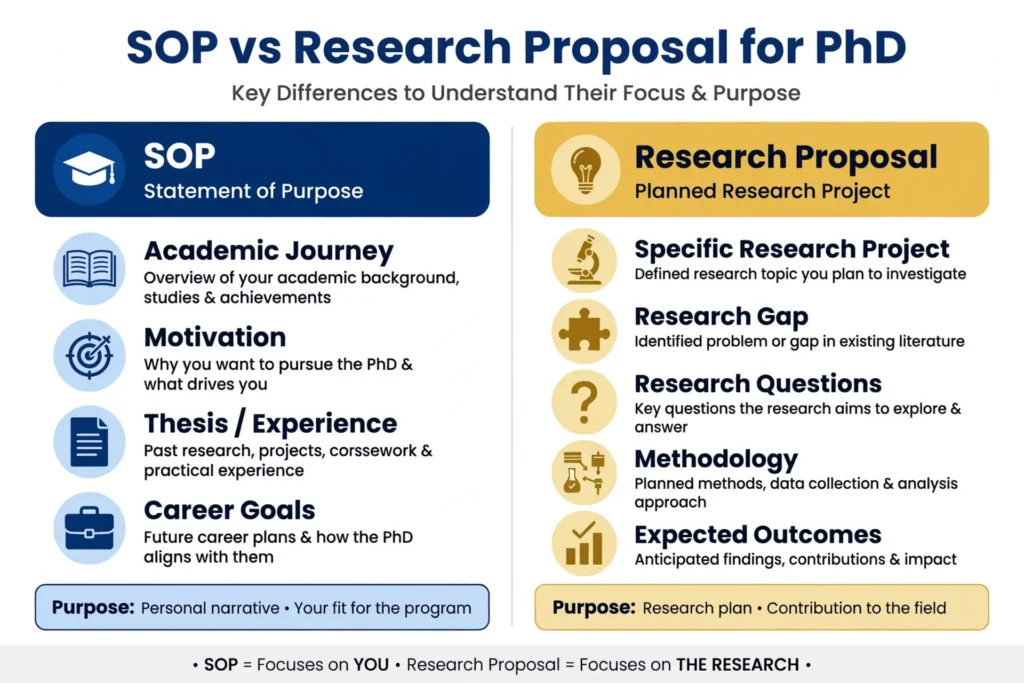
| Statement of Purpose (SOP) | Research Proposal |
|---|---|
| Explains your academic journey and motivation | Explains a specific proposed research project |
| Describes previous research experience & thesis | Identifies a distinct literature gap or problem |
| Discusses your overarching research interests | Defines precise research questions and hypotheses |
| Explains why you selected the programme/university | Describes the proposed methodology & experiments |
| Discusses your long-term career goals | Explains expected findings and academic contributions |
💡 Do Universities Require Both Documents?
Not always. Requirements vary by university and academic programme. For instance, top institutions like Oxford, Cornell, and UC Berkeley specify course-by-course instructions—some require an SOP, others a Research Proposal, and certain programmes demand both. Always verify the target department portal before applying.
3. What Do PhD Scholarship Committees Look for in an SOP?
Academic Preparation
Proof of strong subject foundation required for rigorous doctoral studies.
Research Experience
Details of your MS/MPhil thesis, laboratory skills, publications, or project contributions.
Clear Research Direction
A focused understanding of the specific sub-field or scientific questions you wish to explore.
Programme & Faculty Fit
Direct synergy between your research interests and the department’s current faculty labs.
4. How to Write an SOP for PhD Scholarship 2027 – Step by Step
💡 Need Supervisor Approval Before Submitting Your SOP?
Many PhD scholarships require contacting potential supervisors beforehand. Read our comprehensive guide on how to email professors for scholarships to get free, battle-tested email templates.
5. Recommended PhD Scholarship SOP Format
| SOP Section | What to Include |
|---|---|
| Introduction | Core research interest, primary motivation, and PhD program objective. |
| Academic Background | Bachelor’s & Master’s degrees, coursework, and scientific training. |
| Research Experience | MS/MPhil thesis project, research techniques, data analysis, and findings. |
| Research Interests | Intended research direction, problem statement, and scientific relevance. |
| University Fit | Department suitability, lab infrastructure, and potential supervisor alignment. |
| Career Goals | Future academic, research, or development sector plans. |
| Conclusion | Final summary of research commitment and motivation. |
6. Complete PhD Scholarship SOP Sample
Below is an illustrative Statement of Purpose sample for an applicant with an MPhil background applying for a PhD in Plant Sciences. Customize the highlighted areas with your actual qualifications and research project details:
🔬 PhD Scholarship Statement of Purpose Sample
Statement of Purpose – PhD in Plant Sciences
My interest in plant sciences developed during my undergraduate education when I became interested in understanding how environmental conditions influence plant growth and agricultural productivity. During my postgraduate studies, this interest developed into a stronger research motivation, particularly in the areas of plant physiology and environmental stress. I now wish to pursue a PhD in Plant Sciences to gain advanced research training and contribute to scientific knowledge in this field.
I completed my Bachelor’s degree in Biological Sciences and later obtained an MPhil degree in Plant Sciences from a university in Pakistan. My academic education provided me with a foundation in plant physiology, genetics, ecology, and research methodology. During my postgraduate studies, I became particularly interested in understanding the effects of environmental stress on plant development and the mechanisms that help plants survive changing conditions.
My MPhil research focused on the response of selected plant species to environmental stress. Through this research, I gained experience in reviewing scientific literature, preparing research experiments, collecting data, and interpreting research findings. This experience improved my analytical and scientific skills and helped me understand the importance of evidence-based research in addressing agricultural and environmental challenges.
For my doctoral studies, I am interested in exploring plant responses to climate-related stress, particularly drought and temperature changes. I would like to develop a deeper understanding of the physiological and molecular mechanisms involved in plant stress tolerance. I believe that research in this area can contribute to developing more resilient agricultural practices, particularly in countries where changing climatic conditions affect crop production.
I am interested in the PhD programme at [University Name] because its research activities in plant sciences closely match my academic interests. I have explored the department’s research areas and identified opportunities that align with my intended research direction. I believe that working in an active research environment, under suitable academic supervision, will help me strengthen my research abilities and develop a deeper understanding of my chosen field.
Receiving a PhD scholarship would provide me with the opportunity to concentrate on doctoral research and benefit from advanced academic facilities and research training. It would also allow me to work with researchers from different academic backgrounds and gain international research experience.
After completing my PhD, I intend to pursue an academic and research career in Pakistan. My long-term goal is to contribute to scientific research, support higher education, and participate in research projects addressing agricultural and environmental challenges. I hope to use the knowledge and research skills gained during my doctoral studies to contribute positively to my field.
I believe that my academic background, postgraduate research experience, and commitment to scientific investigation have prepared me for doctoral education. I look forward to the opportunity to develop as an independent researcher and contribute to meaningful academic research through this PhD programme.
7. How to Write a PhD SOP Without Publications or Work Experience?
Many MS and MPhil graduates believe they cannot secure a PhD scholarship without published papers. However, publication requirements vary. If you do not have publications, highlight the following academic strengths:
Key Elements to Emphasize:
- MPhil / MS Thesis Contribution: Describe your research problem, methodology, data collection, and analytical findings in detail.
- Technical & Laboratory Techniques: Detail specialized lab instruments or software packages (e.g., SPSS, Python, R, GIS, MATLAB) you used.
- Academic Projects & Internships: Mention coursework presentations, departmental seminars, or lab assistant roles.
8. Common PhD SOP Mistakes to Avoid
- ❌ Writing a General Motivation Letter: A PhD SOP must focus heavily on research methods and academic preparation rather than generic study-abroad desires.
- ❌ Omitting Thesis Details: Failing to explain your MS/MPhil thesis project is a major red flag for doctoral selection panels.
- ❌ Claiming Unconfirmed Supervision: Never claim a faculty member has agreed to supervise you without explicit confirmation.
- ❌ Overemphasizing Financial Need: Focus 80% of your essay on academic capability and scientific goals rather than financial hardship.
- ❌ Plagiarizing Samples: Always write an original statement. Copying sample texts results in immediate application rejection.
9. Final PhD SOP Checklist Before Submission
- [ ] My research interests are clearly explained in the opening section.
- [ ] I have detailed my MS/MPhil thesis, research methods, and technical skills.
- [ ] My proposed research direction matches the selected PhD programme.
- [ ] I have explained why I selected the university and target department.
- [ ] I have mentioned a supervisor only where relevant and according to instructions.
- [ ] My short-term and long-term career goals are realistic.
- [ ] I have strictly followed the required word limit and document guidelines.
🌐 Official University Writing Guidelines & Guidelines References:
- University of Oxford:
🔗 Statement of Purpose Guidelines ↗ - University of Oxford:
🔗 Research Proposal Guidelines ↗ - Cornell University:
🔗 Academic Statement of Purpose ↗ - UC Berkeley:
🔗 Writing Your Graduate Statements ↗ - Yale University:
🔗 Graduate Application FAQs ↗
10. Frequently Asked Questions (FAQs)
📚 Explore Related Academic Writing Guides:
Final Words: A strong PhD scholarship SOP should demonstrate your preparation for independent research and explain why you want to pursue doctoral studies in a particular field. Take time to research your selected university, understand the department’s research areas, and review your SOP before submission.
Disclaimer: EduScholarWeb is an independent educational news portal. The provided PhD SOP samples are for instructional guidance only. Applicants are advised to draft original statements tailored to their research work and institutional requirements.
🚀 Join Our WhatsApp Channel For Daily Scholarship Alerts
Get instant alerts on fully funded PhD scholarships, research grants, and SOP writing resources.