
Applying for a DAAD EPOS scholarship requires more than good academic results and professional experience. Your motivation letter is an important part of your application because it explains why you want to study a particular course in Germany and how the qualification will support your future professional goals.
A strong DAAD EPOS Motivation Letter should connect your academic background, work experience, chosen postgraduate course and development-related career plans. It should also explain how you intend to use your new knowledge after completing your studies.
In this guide, you will learn how to structure your letter, what information to include, common mistakes to avoid and how to prepare a clear and convincing application.
1. What Is a DAAD EPOS Motivation Letter?
A DAAD EPOS motivation letter is a written statement explaining your academic, professional and personal reasons for applying to a selected postgraduate programme in Germany.
DAAD expects applicants to explain:
- Why they want to study the selected course.
- How their academic background relates to the programme.
- What relevant professional experience they have gained.
- Why they have chosen Germany and the particular university.
- How the programme supports their future career.
- How their studies relate to development challenges in their home country or professional environment.
The purpose is not simply to repeat your CV. You should explain the connection between your previous experience, your proposed studies and your future contribution.
2. What Should a DAAD EPOS Motivation Letter Include?
Your letter should follow a logical structure. Each paragraph should provide information that helps the selection committee understand your reasons for applying.
3. How to Explain Your Choice of University and Course
Applicants can apply for a maximum of three postgraduate courses under the EPOS programme.
If you apply for more than one course, DAAD requires you to explain your reasons for choosing each programme and your order of preference in one motivation letter.
For example:
- First choice: Explain why this programme is your strongest academic and professional match.
- Second choice: Describe how this course also supports your career goals and why you have ranked it second.
- Third choice: Explain its relevance and why it is your third preference.
You must submit the same motivation letter to all the postgraduate programmes you select. Do not prepare separate motivation letters for different EPOS courses.
Make sure the letter clearly explains your priorities and does not contain conflicting information.
4. DAAD EPOS Motivation Letter Sample Outline
The following outline can help you organise your ideas before writing your final letter. Replace the information in brackets with your own details.
Opening paragraph
My name is [Your Name], and I hold a degree in [Your Academic Field] from [University Name]. Through my academic studies and professional experience in [Your Professional Field], I have developed an interest in [Relevant Subject]. I am applying for the [Course Name] at [University Name] because I want to strengthen my knowledge and develop skills that will support my future professional work.
Academic background
During my studies, I gained knowledge of [Relevant Subjects or Research Areas]. My academic background helped me understand [Relevant Issue], which encouraged me to pursue further education in this field.
Professional experience
After completing my degree, I worked as a [Job Title] at [Organisation Name]. My responsibilities included [Relevant Duties]. This experience helped me understand the challenges associated with [Professional or Development Issue] and showed me the importance of advanced knowledge in this area.
Course selection
I selected the [Course Name] because its academic focus on [Relevant Course Areas] matches my previous education and professional experience. I am particularly interested in [Specific Subject or Module] because it will help me develop skills relevant to my career objectives.
Development-related motivation
In my professional environment, I have observed challenges related to [Specific Development Issue]. I believe that advanced training in [Relevant Field] will help me contribute more effectively to addressing these challenges through my future work.
Future plans
After completing the programme, I intend to use the knowledge and skills gained in Germany to contribute to [specific professional or development-related goal]. My future plans include [realistic career plan or professional activity].
Conclusion
I believe that the selected programme is an important step towards my academic and professional goals. Thank you for considering my application.
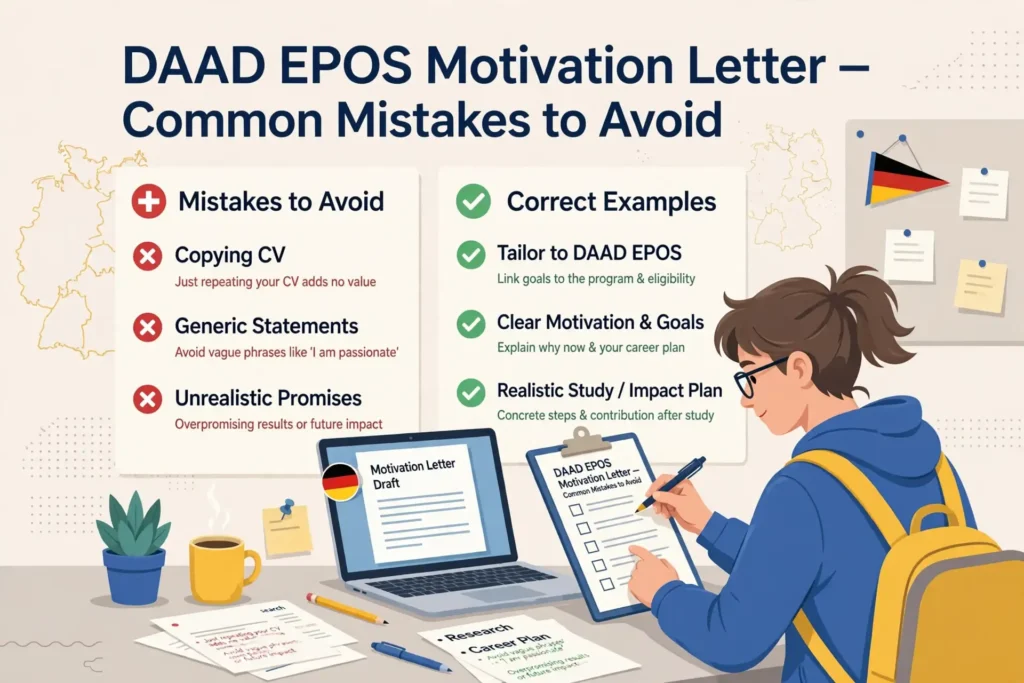
5. Common Mistakes to Avoid in a DAAD EPOS Motivation Letter
A well-written letter can become less convincing if it contains unclear explanations or information that does not match the rest of your application.
Avoid these common mistakes:
- Repeating your CV
Your letter should explain the importance of your academic and professional experience instead of copying your CV. - Using general statements
Statements such as “Germany has an excellent education system” are not enough. Explain why your chosen course is suitable for your specific goals. - Ignoring development-related motivation
Explain how your proposed studies relate to a real issue in your professional field or home country. - Making unrealistic career promises
Your future plans should be practical and connected to your qualifications and work experience. - Submitting different letters for multiple EPOS courses
DAAD requires one uniform motivation letter for all selected EPOS postgraduate courses, up to a maximum of three. You must explain your reasons for selecting each course and your order of preference. - Providing inconsistent information
Your motivation letter, CV, application form and other documents should contain consistent and accurate information. - Using copied or generic content
Do not copy another applicant’s letter or use sample statements that do not reflect your own experience. Your application should represent your actual academic background and professional goals.
6. Final Checklist Before Submitting Your Letter
Review your motivation letter carefully before sending your application.
- Have you explained your academic background?
- Have you described your relevant professional experience?
- Have you explained why you selected the course?
- Have you explained how your proposed studies relate to development challenges and your future professional contribution?
- Have you explained your future career plans?
- If applying for multiple courses, have you explained each choice and its priority?
- Does the information match your CV and DAAD application form?
- Have you checked spelling, grammar and sentence structure?
- Have you followed the university’s specific application instructions?
The complete EPOS application must be submitted in English or German. Check the official DAAD checklist and the selected university’s requirements before submitting your documents.
7. Official DAAD Resources
Always use official sources to confirm the latest application requirements.
Official DAAD Links & Related Guides:
Frequently Asked Questions
Final Advice
Your DAAD EPOS motivation letter should tell a clear and convincing story: what you have studied, what you have learned through professional experience, why you need the selected postgraduate course and how you plan to use that knowledge in the future.
Focus on genuine examples, realistic goals and a clear connection between your experience and the development-related purpose of the EPOS programme. A well-organised and honest letter is more useful than a document filled with impressive but unsupported statements.
🚀 Join Our WhatsApp Channel For International Scholarship Updates
Get real-time updates on DAAD Germany, GKS South Korea, and fully funded international scholarships.