
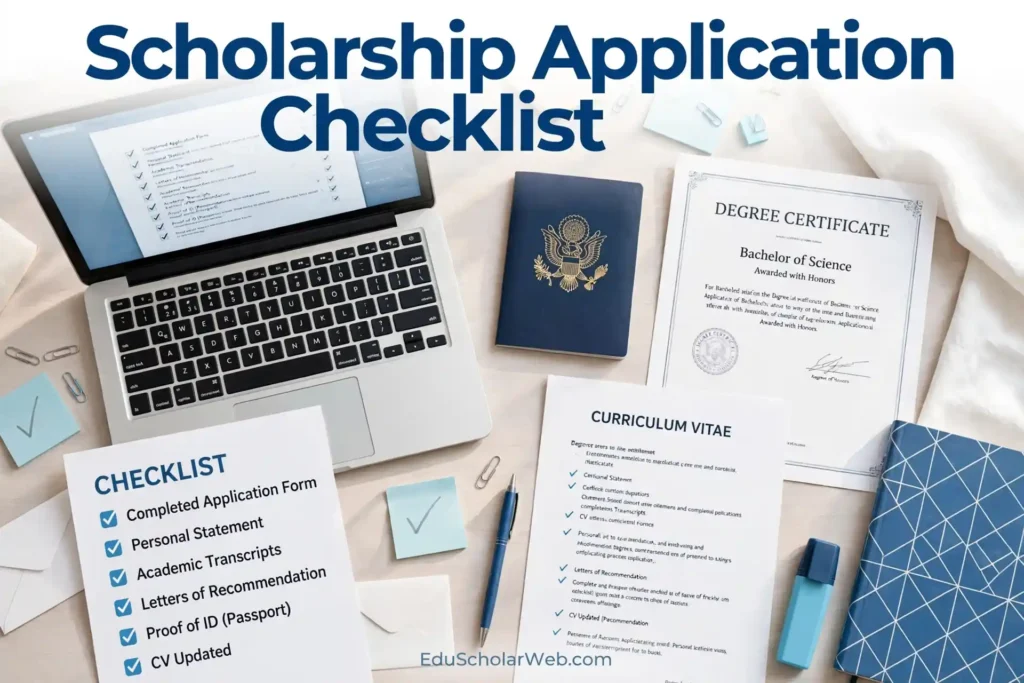
Applying for a scholarship requires more than finding a suitable university and completing an online form. Most scholarship programmes ask students to submit several documents to check their academic background, achievements, skills and study plans. Missing documents or incorrect information can delay an application or make it incomplete.
This Scholarship Application Checklist explains the common documents students may need when applying for undergraduate, Master’s and PhD scholarships. Whether you are applying from Pakistan or another country, preparing these documents early can make the application process easier.
1. Academic Transcripts
Academic transcripts are among the most important documents in a scholarship application. They show the subjects you studied and the marks or grades you received.
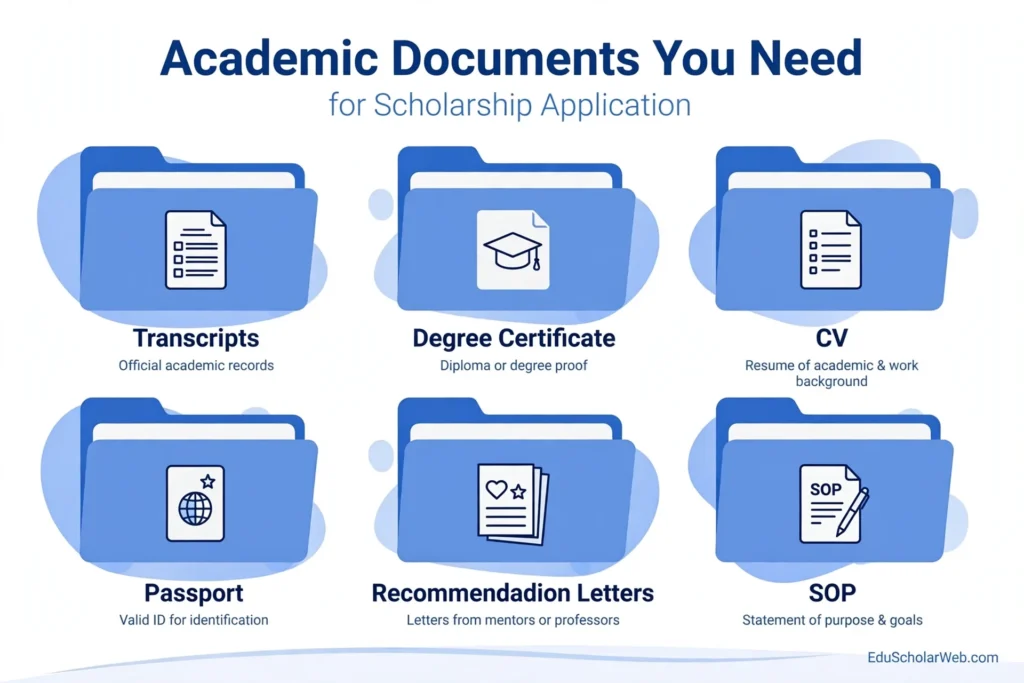
Students may need different transcripts depending on their education level:
- Undergraduate applicants: High school or intermediate transcripts.
- Master’s applicants: Bachelor’s degree transcripts.
- PhD applicants: Bachelor’s and Master’s transcripts, depending on the programme.
Before submitting your transcripts:
- Check that your name and academic details are correct.
- Make sure all pages are clear and readable.
- Include all semesters or academic years if required.
- Submit the official or certified version if the university asks for it.
- Check whether a grading scale or GPA explanation is also required.
If you have not completed your current degree, you may be able to submit available transcripts or a provisional academic record. Confirm this requirement with the scholarship provider.
2. Degree Certificates or Provisional Certificates
A degree certificate provides proof that you have completed a qualification.
For example, a Master’s scholarship may require your Bachelor’s degree certificate. A PhD programme may ask for both Bachelor’s and Master’s certificates.
If your final degree has not been issued yet, check whether the university accepts:
- A provisional certificate
- A degree completion letter
- A final transcript
- An official statement from your institution
Do not submit an unofficial document if the scholarship specifically requires an official certificate.
3. Updated Academic CV or Resume
An academic CV gives the scholarship committee an overview of your education, skills, achievements and relevant experience.
A scholarship CV is not exactly the same as a job CV. It should focus on your academic background and activities related to your chosen field.
A useful academic CV may include:
- Full name and contact details
- Educational qualifications
- Research experience
- Work or teaching experience
- Internships and volunteer activities
- Academic awards and achievements
- Publications or conference participation, if applicable
- Relevant technical and language skills
Keep the information clear and organised. Avoid adding skills or experience that you cannot explain if asked during an interview.
4. Statement of Purpose (SOP)
A Statement of Purpose explains why you want to study a particular subject and how the programme connects with your academic and career goals.
Many universities ask for an SOP as part of their admission or scholarship application.
A strong SOP generally explains:
- Your academic background
- Your interest in the chosen subject
- Important academic or professional experiences
- Why you selected the university and programme
- Your future study or career plans
- How the scholarship will support your goals
Avoid writing general statements that could apply to any university. Explain your actual reasons for choosing the programme.
Some scholarships use different names, such as personal statement, study plan or motivation letter. These documents may have different instructions, so read the exact prompt before writing.
• Griffith University Scholarship 2027 in Australia (Requires a 250–500 word Personal Statement)
• UTS A-Level and IB Scholarship 2027 in Australia (Requires a 500-word Statement + 3-Minute Video)
5. Recommendation Letters
Recommendation letters are written by people who can explain your academic ability, research potential or professional performance.
Depending on the scholarship, you may need one, two or more recommendation letters.
Suitable referees may include:
- University professors
- Research supervisors
- Academic department heads
- Employers or professional supervisors, if accepted
How to prepare:
- Contact your referee early.
- Explain which scholarship or programme you are applying for.
- Share your updated CV and academic details.
- Provide the scholarship deadline and submission instructions.
- Confirm whether the referee must upload the letter directly or give it to you.
A recommendation letter should come from someone who knows your work. A well-informed letter is usually more useful than a general letter from someone with a senior title.
6. Valid Passport or National Identity Document
Many international scholarship applications ask for a passport copy to confirm the applicant’s identity and nationality.
Check the scholarship instructions to see whether you need:
- A valid passport
- A national identity card
- A birth certificate
- Another accepted identity document
If you do not have a passport yet, check whether the application allows you to apply using another identity document and provide the passport later.
Also check passport validity requirements. Some countries require a passport to remain valid for a certain period beyond the expected travel date.
7. English Language Test Results
Some international universities require proof of English language proficiency.
Commonly accepted tests include:
- IELTS Academic
- TOEFL iBT
- PTE Academic
- Other tests accepted by the university
The required score depends on the university, degree level and programme.
Before booking a test, check:
- Which English tests are accepted?
- What is the minimum overall score?
- Are minimum scores required in individual sections?
- How old can the test result be?
- Does the university accept an English-medium instruction certificate or waiver?
Do not assume that every university accepts an English proficiency letter instead of IELTS or TOEFL. The exemption policy must be confirmed on the official admissions website.
8. Research Proposal for PhD Applicants
A research proposal is commonly required for PhD applications and some research-based Master’s programmes.
It explains the research topic you want to investigate and how you plan to study it.
A research proposal may include:
- Proposed research title
- Background of the topic
- Research problem
- Main research questions
- Research objectives
- Brief literature review
- Proposed research methods
- Expected contribution
- References
The required length and format vary between universities and academic departments.
Before preparing a proposal, check the research interests of the department and potential supervisors. Your proposed topic should fit the programme’s research areas.
• Curtin University Dubai PhD Scholarship 2027 (Requires a complete PhD Research Proposal)
• MBZUAI Scholarship 2027 in UAE (Requires a Research Statement & 3 Recommendation Letters for PhD)
9. Scholarship Application Form
Most scholarship providers use an online application portal. Applicants need to enter their personal, academic and programme information.
You may be asked to provide:
- Personal details
- Contact information
- Nationality and residence details
- Educational history
- Employment or research experience
- Selected degree programme
- Referee details
- Scholarship-specific questions
Complete every required field carefully. Make sure the information matches your official documents.
Before submitting the form, review all sections and save a copy of the submitted application if the portal allows it.
10. Additional Documents You May Need
Some scholarships request extra documents depending on the applicant’s background and programme.
These may include:
- Portfolio: Commonly requested for design, architecture, art and other creative programmes.
- Work experience certificate: May be required for professional or postgraduate scholarships.
- Publications and research papers: Relevant for some PhD and research-based applications.
- Financial documents: Some scholarships ask for financial information or supporting evidence, depending on their funding arrangements.
- Disability or special circumstance documents: May be required when applying for specific support or consideration.
- Marriage or family documents: These may be requested for certain dependent or family-related visa arrangements, not as a standard scholarship requirement.
Only submit additional documents when requested or when the application instructions clearly allow them.
11. Do You Need to Attest or Translate Your Documents?
This is an important question for students applying to international universities.
Not every scholarship requires document attestation at the initial application stage. Some universities accept scanned copies for the first assessment and request verified documents after admission.
Requirements can differ according to the country and institution.
Before arranging attestation, check:
- Whether the university requires certified copies.
- Whether documents must be verified by your previous institution.
- Whether a national education authority’s attestation is required.
- Whether documents need embassy or government verification.
- Whether translations must be completed by a certified translator.
For students applying from Pakistan, requirements may involve the Higher Education Commission (HEC) for relevant higher education documents or the Inter Board Committee of Chairmen (IBCC) for certain school-level qualifications.
Official websites:
- HEC Pakistan: https://www.hec.gov.pk/ ↗
- IBCC Pakistan: https://ibcc.edu.pk/ ↗
Do not spend money on unnecessary attestation before checking the scholarship and university instructions.
If your documents are not in the language accepted by the university, you may need an official translation. Submit the original document along with its translation if required.
12. How to Organise Your Scholarship Documents
Keeping your documents organised can help you avoid mistakes when applying to multiple scholarships.
You can create a separate folder for each university or scholarship.
| A simple folder structure could look like this: | Use clear file names, such as: |
|---|---|
|
|
Check the file size, format and page requirements before uploading. Some portals accept only PDF files, while others may have specific file-size limits.
Never upload password-protected files unless the application portal specifically allows them.
13. Common Scholarship Application Mistakes to Avoid
Even students with good academic records can make avoidable application mistakes.
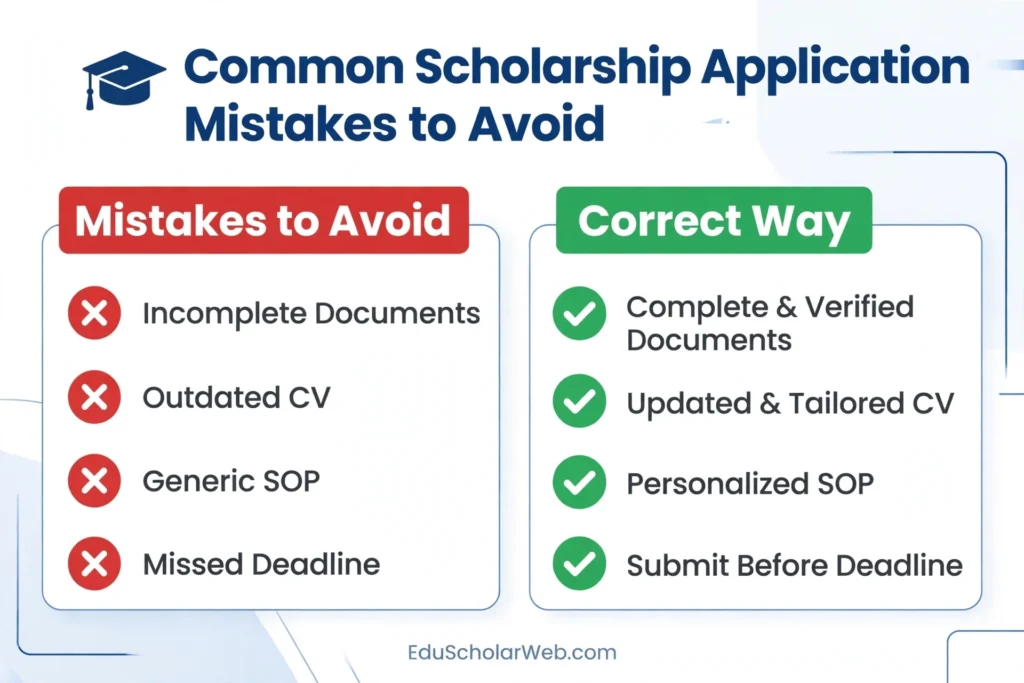
Here are some common problems:
- Submitting incomplete documents: Check every required item before the final submission.
- Using an outdated CV: Update your education, experience, skills and achievements.
- Writing a generic SOP: Explain why the particular programme matches your goals.
- Missing recommendation letter deadlines: Contact referees early and confirm submission.
- Ignoring document instructions: Follow the required file format, size and naming rules.
- Providing inconsistent information: Your name, dates and academic details should match your official records.
- Applying without checking eligibility: Confirm degree requirements, nationality restrictions, academic grades and other conditions first.
- Waiting until the last day: Technical problems, missing documents or referee delays can affect your application.
14. Final Scholarship Application Checklist
Before submitting your application, use this checklist:
- ☑️ I have checked the scholarship eligibility criteria.
- ☑️ I have read the official application instructions.
- ☑️ My academic transcripts are ready.
- ☑️ My degree or provisional certificates are available.
- ☑️ My academic CV is updated.
- ☑️ My SOP or personal statement follows the required instructions.
- ☑️ My recommendation letters are arranged.
- ☑️ My passport or accepted identity document is ready.
- ☑️ My English test result is available, if required.
- ☑️ My research proposal or portfolio is ready, if required.
- ☑️ My documents are translated or attested where necessary.
- ☑️ All uploaded files meet the portal’s requirements.
- ☑️ I have reviewed the application before submitting it.
- ☑️ I have saved the application confirmation or reference number.
🎓 Explore International Scholarship Opportunities
- 🇦🇪 MBZUAI Scholarship 2027 in UAE: Fully Funded MSc and PhD Programs
- 🇦🇪 Curtin University Dubai PhD Scholarship 2027: Fully Funded Research Studentship
- 🇨🇳 Yenching Academy Scholarship 2027 in China – Fully Funded Master’s Program
- 🇦🇺 Griffith University Scholarship 2027 in Australia – 50% Tuition Fee
- 🇦🇺 UTS A-Level and IB Scholarship 2027 in Australia – 50% Tuition Fee
Frequently Asked Questions
Final Advice
A successful scholarship application starts with careful preparation. Before submitting any application, read the official instructions and make sure every document meets the university’s requirements.
Do not prepare documents only because another scholarship asked for them. Requirements can change between universities, degree programmes and application rounds.
At EduScholarWeb, we aim to help students understand scholarship and study abroad processes through practical guides. Always use the official university or scholarship website as the final source of application requirements.
🚀 Join Our WhatsApp Channel For International Scholarship Updates
Get real-time updates on UAE, Australia, China, Germany DAAD, and fully funded 2027 scholarships.